Thursday, 6 March 2014

Curiosity Remains the Same


By Erin Spinney
 
When I first learned the theme for the upcoming Graduate Student's Association Research Conference, I thought that "Curiosity" was a rather frivolous appeal for abstract submissions.  This is not to downplay the epic task of getting scientists, social scientists, humanists, health professionals, and educators to not only be in the same room, but to have a productive dialogue.  However, my opinion changed drastically when our history of medicine panel ran through our presentations on Monday. 

Fedir Razumenko opened his talk with a discussion of the life of a historical research question.  Our interest in a topic has peaks and valleys he argued, we might be passionate about a question one day and be apathetic the next.  The one constant that runs through the whole thing is our curiosity that which got us interested in the first place. 

Anyone who has ever conducted research will recognize the cyclical nature of interest, but the staying power of curiosity might be harder to see.  Graduate students, after all, are busy people and we spend our days juggling many different responsibilities.  We are teaching assistants, research assistants, parents, volunteers, answerers of email, members of student government, and most of us have discovered that trimming down our sleeping time just makes life more difficult.  All of which means that research time unjustly, reluctantly, and much to our supervisor's dismay, is squeezed out of our day.  With this lack of daily engagement with our sources, our curiosity too is buried.   

In order to illustrate the power of research to reawaken our curiosity, I would like to share a quick story from my own research.  My work deals with military and naval nursing in the British empire from 1763-1815.  Presently, I am investigating military hospital organization, and nurse's places in them, during the Napoleonic period.  My research up to last week had been clearly pointing me toward viewing the hospital as a household.  Nurses, orderlies, porters, and others were regularly referred to as servants in the writings of medical officers and in official regulation books.  Then last week, I came across John Hennen's view of the Napoleonic hospital: "We shall now suppose our hospitals filled, our patents laid comfortably in their beds, their diets regulated, and the whole machine in motion."[1]  Well then.  That's different. 


To say that my interest was peeked would be an understatement.  I was positively bubbling.  My curiosity, while it had always been there, just needed a bit of a wake up call.  Hopefully, this will encourage my fellow graduate students to remind themselves why they were curious about their topics too. 


[1] John Hennen, Observations on Some Important Points in the Practice of Military Surgery, and in the Arrangement and Police of Hospitals (Edinburgh: Archibald Constable and Company, 1818), 63.

Tuesday, 4 March 2014

A History Graduate Degree in Three Studies

by Frances Reilly


The Unparalleled Joys of Research!


The Giddy Delights of Writing!!

.... the job search ....

Monday, 17 February 2014

Cultivating an Online Presence: Leading the Academic into the Digital Realm

Originally published on NiCHE here.

by Jessica DeWitt

Several months ago I wrote a piece for my department’s graduate student blog that addressed the need for Humanities students’ to expand their skill set in order adapt to the changing demands of both the academic and non-academic job markets and society at large. Sparked initially by the dialogue that took place during the ASEH 2013 graduate student luncheon panel on non-academic job opportunities, I focused in this post on the benefits of learning and integrating the methods of the digital humanities, specifically GIS analysis, into one’s research. Digital research methods are, however, just one facet of the technological realm with which scholars must grapple in today’s research and employment environment. In a culture where the influence of “googling” (or “binging,” if you prefer) is undeniable, the scholar, particularly the young upstart, is increasingly called upon to both cultivate and manage an online presence.

Last week, Jim Clifford, Jon Bath (Director of the Humanities and Fine Arts Digital Research Centre at the University of Saskatchewan) and I were asked by the History Graduate Student Committee (HGSC) to speak at a workshop entitled “Online Presence Workshop: How History Grad Students Can Survive (and Thrive) in the Digital World.” As the main operator of the HGSC’s Twitter account, I have googled all of the graduate students in the department numerous times in order to publicize our student body’s latest accomplishments. I am repeatedly surprised by how many searches come up with nothing or an outdated snippet from 2007. While it is fortunate that a search of one’s self on the internet does not result in the potentially career-altering party photo montage, the absence of anything is not a keen alternative. Outsiders looking for a quick overview of an individual’s interest may see a blank result and not continue their search. It is of the upmost importance for the graduate student to take on the role of personal publicist because no one is going to take on the position for you: not your department, not your university, not your colleagues.
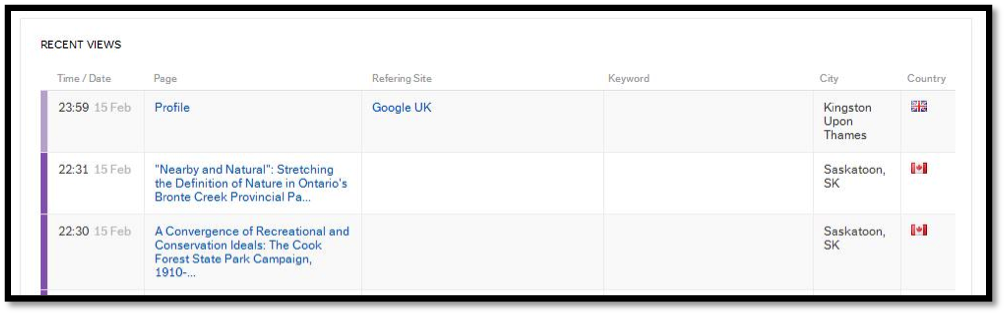
Academia.edu Analytics

The first and most elemental step the graduate student should take is to take advantage of whatever profile and research descriptions one’s department may offer, making sure to keep this profile relatively informational and current. This small step does wonders for enabling others to know about one’s research and the work that one is doing, opening the door for future networking. Beyond this fundamental step, I highly encourage all graduate students to create an www.academia.edu profile. A mix between Facebook and Linked-in, Academia.edu is a kind of online CV, which enables the individual to post their publications, conference presentation, etc. While the social aspect of Academia.edu is ever-so-slowly getting better, I find that there are two main uses for which the site is especially useful. Firstly, if one is googled, one’s academia.edu profile will be one of the top search results. If your profile contains a relatively informational, but brief account of your research and accomplishments, this will be a one-stop-shop for most people searching for a concise description of you. Thus, by creating a profile, such as this one, you are taking direct control of your online persona. Secondly, academia.edu provides an exact record of who is viewing your profile, googling you, and from where they are doing this searching (I find it much more straightforward than the statistics offered by Linked-in). You will be surprised to find that people are searching for you and you may notice jumps after getting on conference panels, winning an award, etc.
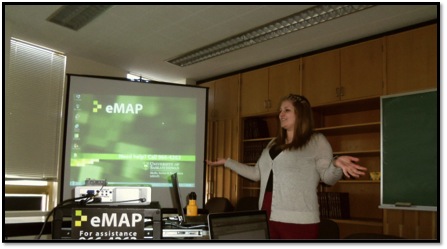
Presenting at the HGSC Workshop

Both Jim and I spoke at the workshop about the benefits of Twitter. A relevantly recent Twitter convert (under a year), I have found the creation of a Twitter account to be one of the best decisions I have made. Recently, Joanne Bailey, wrote a fitting blog post, which discusses the three main ways in which Twitter and other social media is beneficial for the academic: it allows one to increase one’s research network exponentially, it enables one to interact with the public, and it allows one to publicize one’s own accomplishments and writing. One of the greatest hurdles, I find, to preaching the benefits of Twitter to the unconverted is to effectively communicate the utilitarian virtues of the hashtag. Despite the comedic musings of Jimmy Fallon and others, the hashtags like #twitterstorians, #envhist, #cdnhist, etc. provide a superbly effective mean by which to distribute the latest news pertaining to one’s field of study, as well as an easy way to connect with other researchers.

Using activehistory.ca, The Otter, his personal blog, and the blogs of others as examples, Jim spoke to the attendees about the benefits of blogging. One of the key benefits of blogging is that it enables academics to communicate their research and experiences to a broader audience, which is not typically possible with an academic publication. Curating a personal website and writing for other blog’s like The Otter each have their advantages and disadvantages. Personal websites give you more control over your content and offer a useful place to present preliminary research, but they must be updated regularly or they risk appearing out of date. This content of these websites varies from an expanded CV to a full-on blog. One strategy is to use personal websites to chronicle pieces that you have written for other venues. The benefit for writing for larger blogs is that they typically get much more traffic than personal websites. Jon Bath emphasized the importance of making sure that one gets credit for the work that one puts into writing posts for other websites.

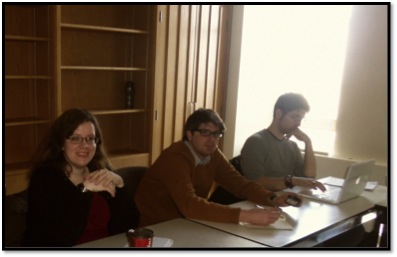
HGSC Workshop Participants
The workshop covered a wide array of topics relating to the academic’s digital presence and incited a number of interesting questions from the attendees, including how one should handle sensitive material that may clearly place one on one political side of a contemporary issue or how to manage the use of archival imagery in one’s online posts. The HGSC is contemplating holding another online presence workshop in the Fall to further explore these issues. It is almost certain that these issues pertaining to online presence will only continue to gain prominence in the lives of graduate students and established academics.

Monday, 11 November 2013

Skills Toolbox: Research

Originally published at Water Cooler Humanities

Skills Toolbox: Research 
By Madeleine Peckham

While the “real” world isn’t very good at sizing up humanities grads’ skills, most people are aware that we have a lot of experience doing research. But what exactly does “research” mean, and how can this academic task be translated into a workplace skill?
Research involves far more than leafing through books or doing online searches. Research is a process.
Knowing how to research is one of the most transferable skills you possess, and one of the most valuable. Sure, you will probably never again be on JSTOR looking for peer-reviewed articles critiquing Juergen Habermas’ characterization of the 18th-century “public sphere”– bummer? hardly– but every job that requires analysis and decision-making requires research.
As I often tell my undergrads, the first part of research is crafting a good question. In a class, this is usually done for you by the professor. At work, it’s often up to you. How you develop your question involves what information you have available, what your time constraints are, and in what format you will be presenting your results and conclusions. A good research project can be seriously hampered by a bad starting question. As in academic research, it’s very important to get a clear handle on what demands the project needs to fulfill before you begin to execute it. Making brilliant conclusions tends not to impress people if you weren’t addressing the question they wanted an answer to.
Second, come up with a data-gathering plan. In grad school, we call this “methodology,” but in the real world, it’s often framed as a response to time constraints. What is the most efficient way of collecting data will allow you to maximize the amount of relevant information on your topic? When I worked at a DC non-profit, I often had to compare pending legislation in several different states. State legislatures used conflicting terminology and organized their databases differently. It was imperative to come up with a plan so that I didn’t have to waste valuable time viewing the thousands of database entries that were irrelevant to my study.
Choose your data wisely. As a TA, I often read papers that I know were “researched” entirely from the first hit on Google. Be sure to consider possible sample biases and be ready to justify your choices of what you select. In the work sphere, this often involves thinking about your sources of data– do they have political leanings? What’s the funding source? Who’s doing the work? What other work have they done?
And now the fun part– analysis. Data, contrary to what a lot of people think, doesn’t just speak for itself. It’s critical that you interpret what you find, keeping in mind how it specifically relates to your research question. Try to make your analysis as clear and concise as possible. The point here is to help people understand what you found, not to wow them with how much effort you put in.

Finally, draw meaningful conclusions. In undergrad papers, most students assume this just means restating what you’ve already presented. In a work situation, you will probably be expected to explain how this will advance company goals, support related projects, or offer an important new perspective. The key to this is to think about why your research question originated in the first place. What was the point of your study and what’s next?

Friday, 25 October 2013

Broadening the Humanities' Skill Set


Broadening the Humanities' Skill Set: The Role of GIS in Positioning the Humanities Student for Academic and Non-Academic Career Achievement

         The internet seems to be burgeoning with humanities doomsday articles lately. Questioning the sanity of humanities students, particularly of the graduate variety, these articles declare that the humanities student is voluntarily choosing a stark future, fighting for the rare tenure track position, scrabbling over the ever-more-coveted, but less than satisfactory adjunct faculty position. However one may feel about these articles (though their points are usually valid, I take their sensationalism with a grain of salt…but that’s another post in and of itself), it is quite apparent that the job market in every sector is shifting and that the humanities student needs to adjust accordingly in order to increase his or her chances of being gainfully employed down the road. These adjustments must necessarily include the consideration of non-academic career options. Our graduate programs tend not to properly prepare graduate students for a non-academic future, which means that the individual graduate student must often take it upon themselves to expand their skills in order to appeal to both the academic and non-academic job market. One of the paramount ways to broaden one’s skill set is to learn and embrace the methods of the digital humanities.

         This past April I attended the annual American Society for Environmental History conference in Toronto, Ontario, during which I sat in on the graduate student lunch. The lunch featured a panel of three historians representing non-academic careers. When asked what skill they wish they had learned that would benefit their current, non-academic career all three responded, “GIS.” Historical Geographic Information Systems involves the application of historical methodology to GIS technology in order to examine the relationship between time, space, and change. GIS can perform similar tasks in other humanities’ fields. For instance, English practitioners can use GIS to map the spatial and temporal literary patterns of an author. Not only useful for one’s graduate research, GIS and other similar skills can be incredibly helpful during the post-graduate job search. As Lauren Wheeler, one of the panelists at the ASEH luncheon, states, “anyone looking for work outside academia needs to have additional skills to get their foot in the door.” Wheeler, who has an MA in Public History from Carleton University and currently works as a Program Lead for the Alberta Museums Association, further states that “with the increasing digitization of industry and communications GIS [is] a particularly useful skill to have as it is not a common additional skill among arts educated graduates.” GIS skills can assist the humanities student in obtaining a job in many spheres of professionalization, including museums, government agencies, non-profits, and agencies that deal with contract work. Examples of the use and integration of GIS technology in these fields and others are many. Three individuals agreed to assist in better illustrating the effectiveness of GIS skills outside academia by sharing with me their own experience with integrating GIS into their humanities background and subsequent non-academic career paths.

         The first contributor is Kaitlin Wainwright, another panelist from the ASEH grad student luncheon, who is currently a Plaques and Markers Program Coordinator at Heritage Toronto, an agency that Wainwright writes is responsible for the interpretation and celebration of the city’s heritage. Wainwright has an HBA in History and Communications Studies and a Master of Arts in Public History from Carleton University. She says that she initially came into contact with GIS when she worked for the National Capital Commission in Ottawa. While at the National Capital Commission, she used GIS to study forest management by “track[ing] the species changes in tree stands in the Greenbelt over a forty year period.” In her current position at Heritage Toronto, Wainwright uses GIS to interpret the history of specific neighborhoods and the city as a whole. By using Google Maps, Wainwright has been able to collect, highlight, and manage the position and content of Heritage Toronto’s plaques and markers. Wainwright points out that many public history organizations are creating mobile applications that have a GIS component. GIS allows people to visually connect with history and the importance of place in history. She states that GIS enables professionals to interpret information and present in a user-friendly format. In her opinion, this is “the core purpose of GIS outside of academia and what makes it useful in a career.”

         Oula Seitsonen has an MA in Archaeology (2004) and MSc in Geoinformatics (2013). He has held a number of positions in the past at private companies and research institutions that used GIS and is currently a field archaeologist/GIS specialist for the Archaeological Museum at the University of Stavanger in Stavanger, Norway and a GIS consultant company, Arkteekki Ltd., where he mainly prepares land use reports, such as groundwater mapping, for surveying and planning purposes. He has found that his knowledge of archaeology and GIS background assists him at his planning job with Arkteekki, Ltd. because he can skillfully guide planners away from sites that are archeologically rich. Seitsonen first started using GIS in 2002 on an old 1990s Geodimeter total state and has improved his GIS skills by way of a mixture of classes, on-the-job training and self-tutelage. He has been actively seeking GIS positions since 2010 when his five-year contract with the Archaeology Department at the University of Helsinki ended and he began studying for his Msc. Seitsonen remarks that the key to enriching one’s career through GIS is to keep one’s self up-to-date on the most recent methods and technologies and to also learn how to deftly sell one’s GIS skills and your academic background to potential employers.

         Brad Duncan holds a Bachelor’s Degree in Social Science and a PhD in Maritime Archaeology from James Cook University. In the past, Duncan has worked for Aboriginal Affairs, Heritage Victoria, a GPS surveyor in New Zealand and a commercial archaeological contractor. Currently, Duncan is a Maritime Archaeologist for the NSW Heritage Division of the Office of Environment and Heritage in Australia. Duncan learned GIS at his first job in New Zealand and in GIS courses in the Geography and Archaeology Departments at James Cook University. Duncan states that he purposefully learned GIS to accompany his archaeological knowledge and used GIS heavily in both his Honors' and PhD theses. GIS is particularly helpful in maritime archaeology and ethnoarchaeological investigations, Duncan contends, because it enables one to overlay multiple data sets and view this data from numerous angles, perspectives and themes. Additionally, he states that GIS is also useful for georeferencing old maps in order to decipher where potential archaeological site may be. Duncan write that all of the job positions he has had can be attributed to his background in GIS. According to Duncan, all archaeological students should be required to study GIS analysis. 

Monday, 7 October 2013

What are the “Liberal Arts,” anyway? – A Reply to Chris Berger

By Dustin McNichol

Originally posted on: www.udaimoniaonline.com


In a well-written and provocative article, Chris Berger argues that the liberal arts are suffering from a serious identity crisis and that apologists who champion them are missing the point. We must therefore, as Berger correctly points out, take a deeper look at what liberal arts and education mean. However, Berger’s argument that the arts’ principal goal is to cultivate the soul also follows an instrumental logic, and again misses the point of what the liberal arts are, and what their purpose is. In this article I propose to further discuss the state of liberal arts and higher education, offering my own proposal(s) for meaningful reforms.

We must first agree on what the “liberal arts” are. Berger explains that they are a “branch” of education, but this is only partially true and clouds our understanding of them in history, since societies perceive and construct educational systems differently throughout time. The Greek model, which stressed civic virtue, also existed alongside geometry (which Plato was particularly fond of) and mathematics; the arts and sciences were not “branches” of education, they were education. This model reigned roughly until the Enlightenment, when a relentless preoccupation with compartmentalizing forms of knowledge began to displace the previous epistemological unity which the Greeks favoured. In the nineteenth century, the ascendency of Darwinian theory and the creation of “social science” disciplines marked the end of the marriage of arts and sciences (to put it into contemporary terms) as disciplines became increasingly specialized and fractured. Only in more recent times have we begun to understand arts as inherently distinct from the sciences.

Whether or not this is a problem or represents some sort of “crisis” for liberal arts is another matter entirely. It is becoming increasingly clear that our current strategies for defending our vocations and forms of knowledge are not successful. Indeed, apologists for the liberal arts ought not appeal to nostalgia, as Berger does, since the Greek model only belonged to an elite and would continue to do so until the Enlightenment, when ideas of citizenship became increasingly universal and men of letters began to appear in groups other than the clergy and political elites. Today’s universities, with their ever-expanding armies of undergraduate, graduate, and post-doctoral students in all disciplines, are in fact the exact opposite of the Greek ideal. Indeed, a liberal arts education is now a popular affair; more than ever, people are being introduced to our common heritage of ideas, great thinkers, politicians, and events.

But even this optimistic understanding of the liberal arts as “liberating” is only partial. The liberal arts are often looked upon positively by apologists who are forgetting a more frightening, and indeed disturbing truth: that throughout history, great thinkers trained in the liberal arts have been complicit in humanity’s darkest moments and events. To take an example, twentieth-century Europe, the (sometimes still) so-called centre of humanistic and enlightened reflection at the time, barbarically smashed itself to pieces during its first half-century with the help of a great deal of highly-educated men and women. The liberal arts bear great responsibility for the tragedies of Europe’s twentieth century. This grim observation is simply to point out that we cannot view the liberal arts nostalgically, or as meaning the pursuit of “justice” as Berger argues. The darker reality of the liberal arts means that justice cannot constitute its unifying principle; there is no “golden age” when the arts were not captive to human desires, temptations, and flaws. But its ambivalence offers us a clue as to our predicament, since the liberal arts seems to not only signify thinking about humanity, but being human and participating fully in all of our successes and failures.

On what grounds, then, can the liberal arts be defended? Widely defined, the liberal arts – a body of different humanistic forms of knowledge – cannot be separated from their function; in other words, what the liberal arts are is also what they do. More specifically, they ask questions. The act of learning necessarily turns on the asking of questions and the confrontation of our own ignorance; knowledge acquired, in turn, provokes more questions. We must, then, see the liberal arts as centred around the questioning of society, humanity, reality, history – anything and everything that is human and that humanity interacts with. This is not an end in itself but rather a process. To take an analogy from Plato as Berger has done, Plato’s cave not only signifies a destination or end goal (the leaving behind of ignorance) but also the process of searching for light and truth, whatever that may be. The liberal arts have always asked questions and sought answers, and will continue to do so because the act of questioning is universally human. Here we can find common ground for a robust defense of our function in universities and in societies.

I do not mean that questioning and thinking in the liberal arts refers uniquely to deconstructing and “understanding” our reality; quite the opposite. We need to reach beyond truth towards what is beautiful, human, imperfect, even contradictory. Nietzsche famously said that he did philosophy “with a hammer”; indeed, a hammer can destroy and tear down, but it is also used to construct, to create, to build. To put it differently: asking “what is truth?” can end a conversation; what it really does, however is create a new one. Questioning is what the liberal arts are all about, from the ancient Greeks to the postmodernists.

We need to change the conversation about liberal arts. This cannot be done, as many believe, by finding a unifying principle such as justice, or preserving some sort of traditional model for our disciplines. We must continue to live in our society and engage with it as previous thinkers, politicians, academics, and artists have done. This website is an excellent example of the liberal arts in the twenty-first century.

Changing the conversation about liberal arts means taking the liberal arts’ timeless, universal, and central function – asking questions – and applying it to today’s new forms of education. It means creating new ways of seeing humanity. It means that university professors can no longer ignore the massive changes that the Internet and technology have wrought in our societies. It means that the question of employment and “usefulness” of a B.A. must be dealt with seriously, not simply ignored as “capitalistic” or besides the point. We must make sure that the intrinsic value of questioning is not forgotten in the deafening cacophony of media and popular discourse that insists that we are in a crisis. We must not allow discursive nonsense that disenfranchises our purpose as liberal arts graduates and creative/critical thinkers go unanswered. The liberal arts still have much work to do in this respect.

There is one final and much more important question that should be considered seriously: is the “liberal arts crisis” real? Perhaps the fact that we view our disciplines with such criticism, and that we are on the agenda of many major universities, shows that we are doing our jobs. Perhaps there is no crisis in liberal arts education except for the one that we have created ourselves.


What are the “liberal arts”? Kudos to Chris Berger for questioning them – we should all continue to do so.

CC photograph on Flickr courtesy of “sparkovonovinski.”

Tuesday, 17 September 2013

Spreading Research Through Media

As historians it is important for us to reach as wide an audience as possible.  One way to do this is to interact with non-print media.

Check out the following youtube videos featuring PhD candidates Omeasoo Butt and Victoria Lamb-Drover:


Listen to recent M.A. graduate Sarah York discuss Saskatoon's early sex trade on CBC radio: